Engage students with a captivating introduction to plant stems by discussing their importance in plant survival and growth. Highlight the connection between roots and shoots and the role of stems in support and transport.
Go to the LessonLesson Plans
Plant Structures – Stems
Learning Objectives
- Understand the role of the stem in connecting the root system to the shoot system and providing support for the plant.
- Explain the functions of xylem and phloem in transporting water, minerals, and food throughout the plant.
- Differentiate between herbaceous and woody stems, including their characteristics and examples.
- Identify how certain plants use their stems for storage of food and water.
- Discuss the protective role of bark in woody stems and how it helps plants survive in extreme conditions.
Introduction and Hook
Introduce the concept of xylem and phloem with a brief explanation of their functions in transporting water, minerals, and food throughout the plant.
Direct Instruction
Use diagrams and models to explain the structure of stems, focusing on the differences between herbaceous and woody stems. Discuss examples of each and their characteristics.
Show the video 'Parts of a Plants – Roots, Stems and Leaves' to visually demonstrate the functions of stems in plant biology. This video aids in understanding how stems support and transport resources.

Guided Exploration
Facilitate a discussion on how certain plants use their stems for storage of food and water, using examples like bamboo and cacti.
Explore the protective role of bark in woody stems and how it helps plants survive in extreme conditions.
Hands-On Activity
Conduct a hands-on activity where students examine different plant stems and classify them as herbaceous or woody. Encourage them to note characteristics such as flexibility, color, and texture.
Independent Practice
Assign students to research and create a fact sheet on a plant of their choice, focusing on stem type, function, and adaptations.
Check for Understanding
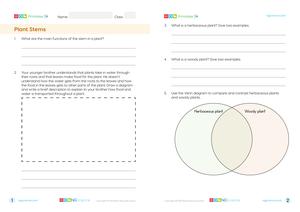
Use the 'Plant Stems' assessment to evaluate students' understanding of stem functions and types. This assessment includes diagram drawing and Venn diagram activities to reinforce learning.
Review and Reflection
Have students reflect on what they learned about plant stems and their importance. Encourage them to share insights and questions with the class.
Assessment and Extension
Assign the 'Plant Classification – Comprehension' assessment to test students' understanding of plant diversity and classification. This assessment includes activities like filling in blanks and using Venn diagrams.

Encourage students to take the unit quiz to assess their overall comprehension of plant structures and functions.
Try the Quiz